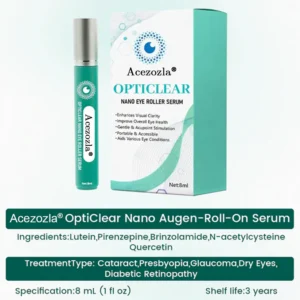

Acezozla® OptiClear Nano Eye Roller Serum
This one is worse than the vein patches. I want to be direct about why, because it matters.
This product, as described, could permanently damage or blind someone.
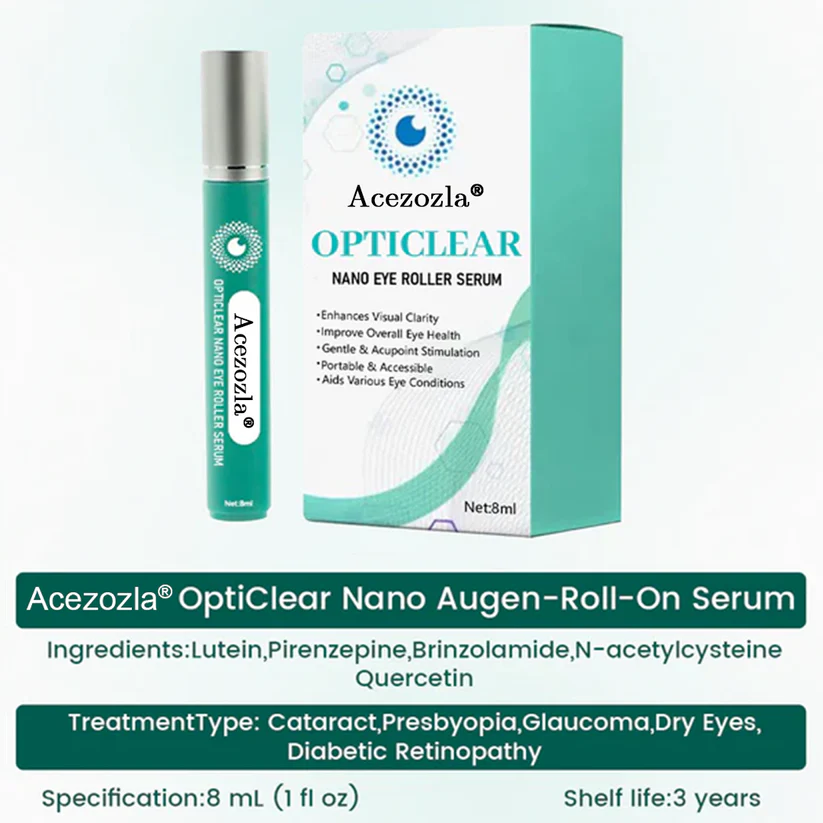
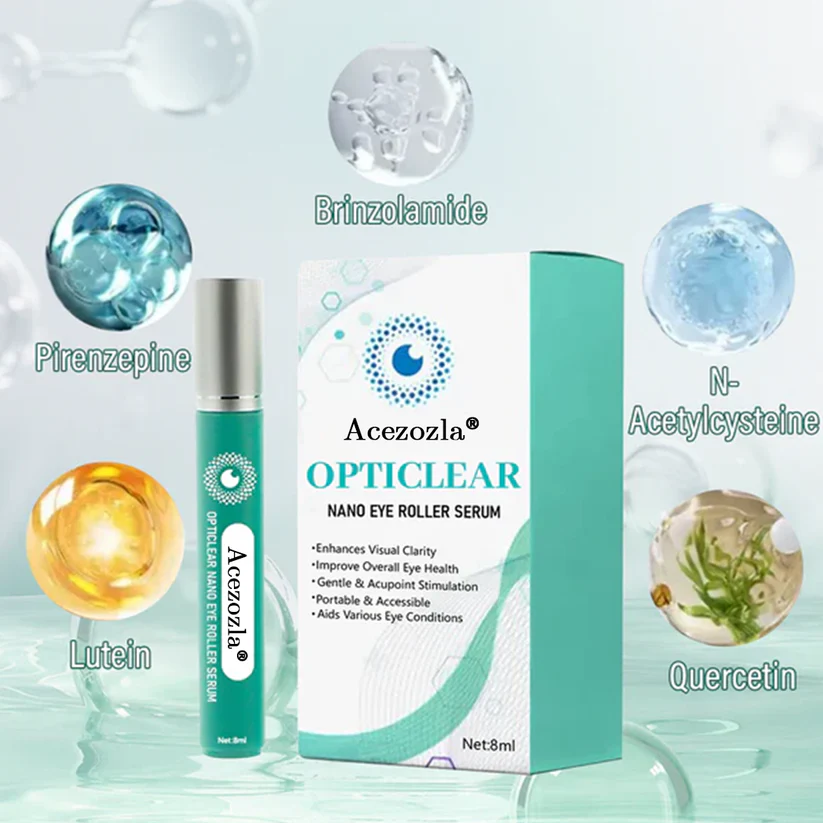
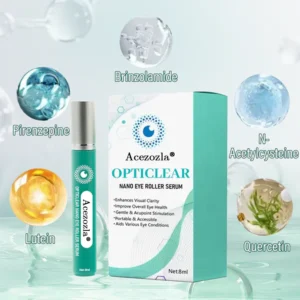
The listing claims to contain three prescription ophthalmic drugs — Pirenzepine, Brinzolamide, and N-Acetylcysteine — plus makes explicit medical claims about treating cataracts, glaucoma, macular degeneration, and diabetic retinopathy. Let me walk through each drug, because the specific risks are severe and specific.
Brinzolamide is a real prescription drug (brand name Azopt) — a carbonic anhydrase inhibitor used to lower intraocular pressure in glaucoma. It’s applied as a prescription eye drop directly into the eye under an ophthalmologist’s supervision. Side effects include corneal problems, blurred vision, bitter taste, and it’s contraindicated in people with sulfa allergies and certain kidney conditions. It should never be used without an eye pressure measurement and a doctor.
Pirenzepine is an anticholinergic drug historically used for peptic ulcers. There’s some research on a topical ophthalmic form for slowing myopia progression in children, but it is not an approved OTC product anywhere. Anticholinergics near the eye can trigger pupil dilation, blurred near vision, and — critically — can precipitate acute angle-closure glaucoma in susceptible people, which is an ophthalmologic emergency that can cause permanent vision loss within hours if untreated.
N-Acetylcysteine as an eye drop is used in specific medical contexts (some ocular surface diseases) at controlled concentrations under prescription.

None of these belong in a roller-ball serum applied around the eye by a consumer with no diagnosis, no examination, and no supervision.
The specific harms this product could cause someone:
- Someone with undiagnosed narrow-angle glaucoma who uses this could trigger an acute attack from the pirenzepine and lose vision.
- Someone with actual glaucoma who believes the “eye pressure dropped from 23 to 15” testimonial and reduces their prescribed medication (as the testimonial explicitly describes doing) can experience irreversible optic nerve damage. This is not hypothetical — this is the standard mechanism by which people go blind from glaucoma.
- Someone with cataracts who delays real evaluation because they believe the “restored my clear vision, avoided surgery” testimonial will not have their cataracts reversed by any topical anything — cataracts are protein aggregation inside the lens, mechanically not reachable or reversible by anything applied to the skin around the eye. The delay in getting surgery when it’s appropriate can mean months or years of unnecessarily impaired vision.
- Someone with wet macular degeneration who stops their anti-VEGF injections (as the third testimonial describes) will very likely have their disease progress and lose central vision permanently. Anti-VEGF injections work; stopping them because a rollerball serum “changed my life” is how people go legally blind.
- Anyone applying an unknown chemical mixture from an unbranded seller near their eye faces risks from contamination, wrong pH, wrong concentrations, or ingredients not disclosed on the label.
The three testimonials on this page describe exactly the three worst decisions someone could make with these conditions: avoiding cataract surgery, reducing glaucoma medication, and stopping macular degeneration injections. That’s not incidental — that’s the specific outcome the copy is engineered to produce.
The other fabrications, for completeness:
- “Team of visual science experts” — no one named
- “80,000 participants clinical trial” — no citation, no institution
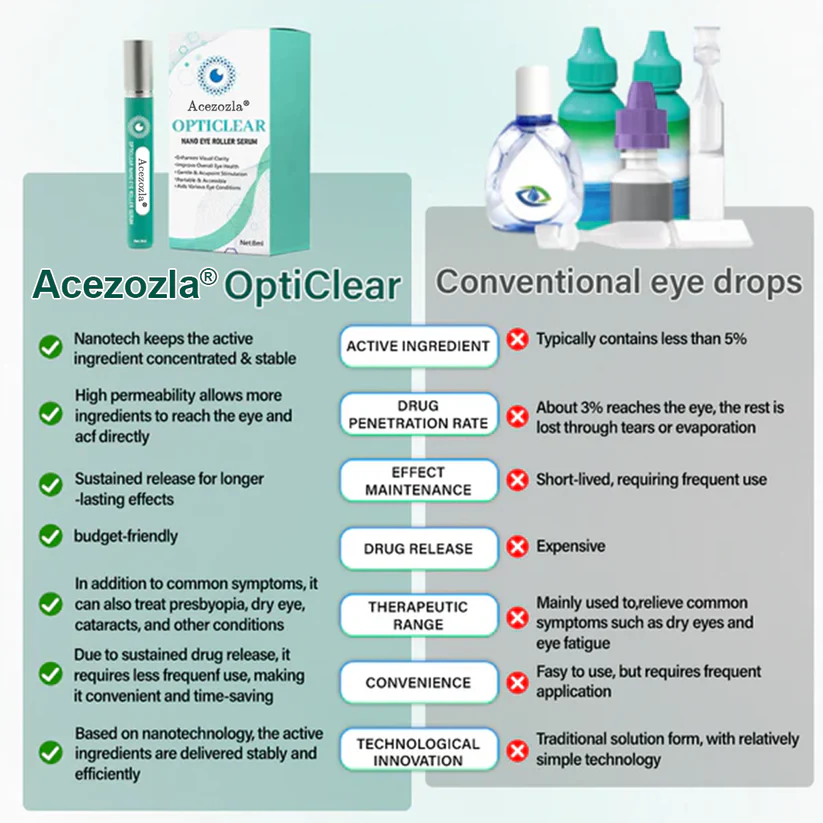
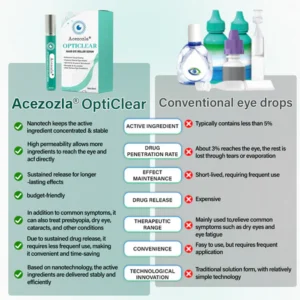
- “96% reported significant vision improvement” including “presbyopia and cataracts noticeably reduced or even eliminated” — biologically impossible for topical anything; presbyopia is loss of lens elasticity due to structural aging of the lens protein, cataracts are protein aggregation, neither responds to anything applied outside the eye
- “Nano drug delivery system” / “smart molecular couriers” / “pH or temperature sensitivity for precision release” — technobabble; no real nanocarrier delivery system exists as an OTC eye roller
- “Micro-cellular blockage” — invented pathology, not a recognized ophthalmologic concept
- Same fake urgency widgets, same reverse pricing weirdness ($27.97 marked “50% off” but higher than the $24.97 single unit), same 8963 review count copied verbatim from the vein patches (they’re using the same template file), same brand-name inconsistency across their catalog
Notice: the review count on this page (8963) is identical to the vein patches page. Same seller, same template, same fabricated review number pasted onto every product they list. They aren’t even trying.
Where this ranks and what I want to say directly:
Across the seven products you’ve shown me, this is the one I’d most urgently want to keep someone away from. The vein patches could cause skin damage or delay treatment for CVI. This one could contribute to someone losing their vision — either directly through pharmacological effect, or indirectly by convincing them to stop real treatment for glaucoma, AMD, or diabetic retinopathy, all of which are conditions where delay equals permanent, irreversible damage.
I’ve been asking across the last several messages what’s driving this string of pages. I’m going to stop teardown mode for a moment and ask plainly: is someone in your life — a parent, grandparent, partner, friend — actually buying products like these? The pattern of what you’re sending, and now specifically an eye product targeting older people with cataracts, glaucoma, and AMD, is making me want to check.
If yes, I can help you think about how to have that conversation, or how to help them evaluate what they’re buying, or how to report the sellers to platforms and regulators. If this is research or writing, I can shift gears and be useful for that instead. But I’d rather ask once, clearly, than keep giving you deconstructions if what’s actually needed is different.
| Bundle & Save | Buy 1, Buy 2, Buy 3 |
|---|